Old World Skurling Federation · Rulebook v1.6 · Printed on
Skurling
The noble art of throwing a friend across the pitch and then hitting him until he gets there.
Concept
Skurling is a sport for two teams of five Blood Bowl miniatures.
At the start of each arc one member of the attacking team, the Stooge, is thrown by a teammate. From that moment his own two Whackers beat, shove and generally encourage him towards the opposing end zone. The Stooge is also the ball: the more battered he is when he arrives, the less he is worth.
The throw comes from curling and the fighting from Blood Bowl. The Stooge has volunteered. Officially.
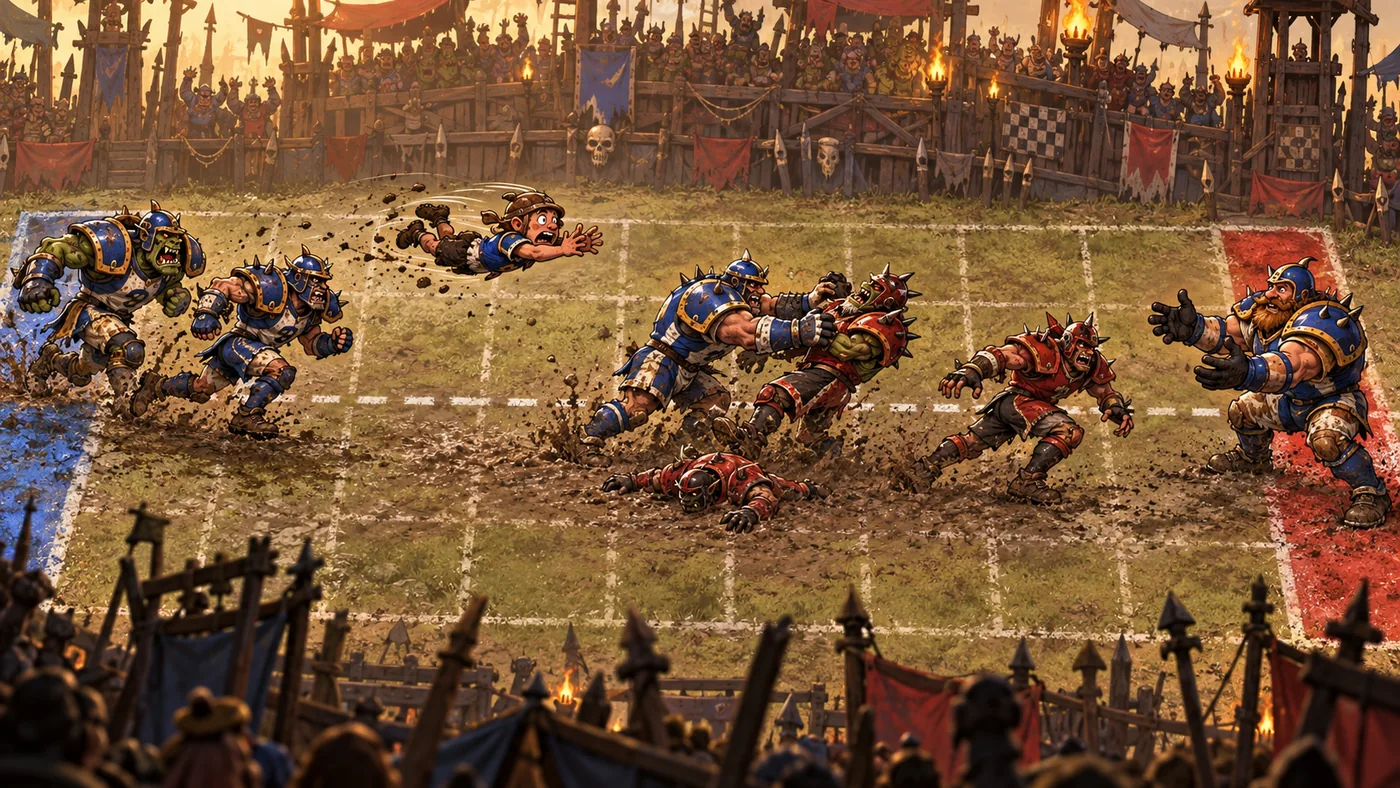
Blood Bowl rules apply (blocks, assists, pushes, armour, catches, Throw Team-Mate) unless this book says otherwise. Stat values are those of the miniature, and teams may mix races freely. Where Skurling has no good reason to change a Blood Bowl rule, it doesn't.
Equipment & pitch
- Miniatures: 5 per team, from Games Workshop or any third-party maker. Races may be mixed within a team. You need each miniature's stat line and the Blood Bowl dice (block dice, d6, d8).
- Pitch: the Blood Bowl pitch, on squares. Play happens only in the two wide zones (the side lanes). The centre field is not used and holds sidelines, benches and crowd, and you can dress it with (made by the Odds & Ends Guild): free props that make the table look like an arena. There are no trapdoors, which the Stooge regrets.
- No dugouts: Skurling has no dugouts. Everything the two teams need lives in the centre field: the bench for the Stooge and the defenders' reserves, and, in a league, the Reserves, the KO box and the Casualty box. Each team keeps its own side of the centre field, next to its own lane.
- Direction: in every arc the Stooge travels from one end zone to the other along the wide zone chosen by the attacker.
- Line of scrimmage: used only to place the Goon and to limit where defenders may set up.
Your first match
Two players, two ready-made teams, about thirty minutes.
You do not need to read the whole book to play your first Skurling match. Here are two teams you can build from the most common Blood Bowl miniatures, the few rules you really need and a step-by-step first arc. Everything else can wait until the second match.
What you need
- Ten miniatures: the two teams below, or any you already have, with their stat lines.
- The Blood Bowl dice (block dice, a d6, a d8) and the Blood Bowl pitch, or the cheat sheet, which shows the lane and the set-up.
- Optional: a small bell for the ding-dong.
Two ready teams
Both are legal one-off teams of 400K at most, built from a single roster each, with the roles already assigned. Open one in the Team builder to see it, change it or print its team sheet.
Old Road Rovers (Human roster) — 395K
| Role | Miniature | MA ST AG PA AV | Skills | Cost |
|---|---|---|---|---|
| Stooge | Halfling Hopeful | 5 2 3+ 4+ 7+ | Dodge, Right Stuff, Stunty | 30K |
| Whacker | Ogre | 5 5 4+ 5+ 10+ | Bone Head, Loner (3+), Mighty Blow, Thick Skull, Throw Team-Mate | 140K |
| Whacker | Human Lineman | 6 3 3+ 4+ 9+ | — | 50K |
| Goon | Human Lineman | 6 3 3+ 4+ 9+ | — | 50K |
| Cuddler | Human Catcher | 8 3 3+ 4+ 8+ | Catch, Dodge | 75K |
| 1 team re-roll (50K) | 50K | |||
Black Crag Crushers (Orc roster) — 400K
| Role | Miniature | MA ST AG PA AV | Skills | Cost |
|---|---|---|---|---|
| Stooge | Goblin Lineman | 6 2 3+ 4+ 8+ | Dodge, Right Stuff, Stunty | 40K |
| Whacker | Troll | 4 5 5+ 5+ 10+ | Always Hungry, Loner (4+), Mighty Blow, Projectile Vomit, Really Stupid, Regeneration, Throw Team-Mate | 115K |
| Whacker | Orc Blitzer | 6 3 3+ 4+ 10+ | Block, Break Tackle | 85K |
| Goon | Orc Lineman | 5 3 3+ 4+ 10+ | — | 50K |
| Cuddler | Orc Lineman | 5 3 3+ 4+ 10+ | — | 50K |
| 1 team re-roll (60K) | 60K | |||
Why these? Each has one Right Stuff miniature for the Stooge and one big Whacker with Throw Team-Mate to throw him. Neither Cuddler has Throw Team-Mate, so in this first match nobody can go for the ding-dong: the catch is always worth the 2 points, which keeps the decisions simple. You can build your own teams with the team building rules whenever you like.
Leave these out the first time
- Pre-Match extras: no Pebblemuck, no Weather, no Fans. Play on plain ground and skip the Fan Factor.
- Extra rules: no Stooge helmets, no seasonal weather, no grounds.
- Landing events: skip the roll after the Stooge lands. Add it from the second match, when you want a bit more chaos.
- Inducements, Sidelines and the Gaffer: not needed. No Petty Cash either.
- League rules and the Throwback Night: a first match is a friendly one-off game.
Before the first arc
- Toss a coin: the winner chooses who attacks first. The attacker chooses the lane.
- Set up as shown in Arc setup: the Stooge and both Whackers in the starting end zone, the Goon beyond the line of scrimmage, the Cuddler in the destination end zone. The defenders place four miniatures on their side of the line, one of them right in front of the Goon.
Your first arc, step by step
- The throw. The attacker's first action: a Whacker with Throw Team-Mate throws the Stooge, with the normal Blood Bowl Throw Team-Mate rules. The Stooge lands Stunned. He is worth 3 points if he arrives like that.
- The Touch. Now the attacker's Whackers and Goon block the Stooge with the usual block dice and assists. The hitter chooses the direction (straight ahead or one of the two diagonals) and the Stooge moves by the squares shown: Push Back 3, Defender Stumbles 2, Pow 1, Both Down 1, Player Down 0. Beware: Stumbles and Pow knock the Stooge down and force an armour roll, which can make him worth less. The Goon moves him only 1 square.
- The defence. The defenders may hit the Whackers, the Goon and the Cuddler, never the Stooge. They can also stand in his path: he pushes them away.
- The goal. The Stooge scores the moment he enters the destination end zone: 3, 2 or 1 point according to his state. If he enters the Cuddler's square, the Cuddler tries to catch him, as in Blood Bowl: +2 points.
- The end of the arc. The arc ends when the Stooge scores or after the attacker's eighth turn. Then reset: the teams swap roles, and the new attacker chooses the lane.
The five things to remember
Only the lane
Play happens in the two side lanes. The centre field is just benches and crowd.
Never the Stooge
Defenders cannot hit or push the Stooge. Only his own team does.
The Stooge only gets worse
3 points when Stunned, 2 when KO, 1 when Casualty. Armour rolls decide it.
No turnovers
If a miniature falls, the turn goes on. One Blitz per team per turn.
First to 10
The first team to 10 points wins, after both have attacked the same number of times.
Printable page. The two teams, the first-arc steps and the five rules on one A4 page, to keep next to the pitch. Download the PDF
After the match, tell us how it went: what was clear, what was not, which team won. Every playtest report helps.
Team building & roles
A team has 5 miniatures, a budget and two trait constraints. Everything else is free.
- At least one Whacker has the Throw Team-Mate skill.
- Exactly one miniature has Right Stuff. It is the Stooge. At most one Right Stuff miniature may be on the pitch at any time, so a team never fields two.
Any miniature with Right Stuff may be the Stooge, whatever its race or stats.
Which positions are allowed
- Any position of any Blood Bowl 2025 roster, at its Blood Bowl cost. The per-position limits of Blood Bowl (“0-2 Blitzers” and so on) do not apply: a team of five Bug Guys is legal, and pays for it in speed, Bone Head and the rest.
- No Secret Weapons. Positions with the Secret Weapon skill (Chainsaw, Bombardier, Ball & Chain and the like) are not allowed: the lane is too narrow for them.
- No Ball positions are allowed, but they cannot catch the Stooge, so they can never be the Cuddler. They have no hands for it.
Budget
A team is built with a maximum of 400K gp. Unspent gold is simply lost (in a league it goes to the Treasury); there is no minimum. Costs are the pure Blood Bowl 2025 costs of each position, with no adjustments, and races may be mixed freely. The cheapest legal team costs 250K (Snotling Stooge 15K, Troll 115K, three 40K linemen). Typical legal teams cost about 425K, so 400K forces real choices. The Whacker with Throw Team-Mate (115–140K) is the heaviest single cost.
Team re-rolls
Teams buy re-rolls from the same budget, with no cap on the number, and use them as in Blood Bowl: they refresh at every interval (see End of arc), and at most one may be used per turn. The cost of a re-roll is the Blood Bowl re-roll cost of the roster the Goon was taken from, declared when the team is built. Loner applies as in Blood Bowl.
Inducements
See Inducements. They also come out of the 400K.
Sidelines
Permanent staff, bought from a separate 80K budget. See Sidelines.
Team roster sheet. Print it, fill it in, bring it to the table: squad and stat lines, budget check, inducement tracker and a match log with intervals. Two A4 pages. Download the PDF
Roles
At the start of every arc the attacker assigns roles to the four other miniatures. They may change role from one arc to the next.
Stooge
The miniature with Right Stuff. It is thrown and then hit by its teammates, and it is the ball. It never leaves the pitch.
Whacker
At least one has the TTM skill and makes the opening throw. Then they hit the Stooge (Touch) to push him forward.
Goon
Starts beyond the line of scrimmage and clears the way for the Whackers. It may hit the Stooge, but moves him only 1 square.
Cuddler
Stands in the destination end zone and attempts to catch the Stooge when he arrives there. With Throw Team-Mate he can throw him back: The Ding-Dong.
On defence, 4 miniatures out of 5 play. The Stooge, as the only Right Stuff miniature, stays on the bench, in the centre field, for the whole arc.
Pre-Match actions
Before the first arc the two coaches go through these steps, in order.
- The Pebblemuck. Roll 2D6 on the Pebblemuck table, then a D6 for its Attribute (see Pebblemuck), or pick a preparation by agreement. There are no home pitches.
- The Fans. Each coach rolls a D3 and adds his team's Dedicated Fans (every Skurling team has 1). The result is the team's Fan Factor (FF). The two FF values added together give the Fan Attendance (FA), used to work out the winnings in a league match. FF also matters in two Landing Events (Cheering Fans and Bonspiel Brawl).
- The Weather. Each coach rolls a D6. The two results are added together and checked on the Weather Table (or on the seasonal or ground table in use, if the league uses those extra rules).
- Inducements. Compare the teams' Team Value (TV): the cost of the five miniatures and the team re-rolls, not counting inducements. If the values differ, the lower-TV team receives Petty Cash. Resolve in order: (a) the higher-TV team may spend gold from its Treasury on Inducements (leagues only; one-off games have no Treasury); (b) the lower-TV team receives Petty Cash equal to the TV difference plus whatever the higher-TV team spent; (c) the lower-TV team may spend its Petty Cash, and in a league up to 50K from its Treasury on top. Unspent Petty Cash is lost. If the TVs are equal, neither team may spend from its Treasury. Inducements bought here are in addition to those bought at team building; there is still only one of each type per team.
- Determine First Attacker. Flip a coin, or each coach rolls 2D6 and the higher result wins. The winner decides whether his team attacks or defends in the first arc. From then on roles swap after every arc, as described in End of arc.
Skurling follows the Blood Bowl pre-match sequence, with these changes: there are no Journeymen in one-off games (every team always has its five miniatures; leagues have a Journeyman rule), and the kicking team becomes the first attacker.
Weather
The weather is rolled once in the pre-match sequence and again whenever the Changing Weather Landing Event comes up. It applies to every arc until it changes. If your league uses the extra rules, the weather may come from a seasonal or a ground table instead.
| 2D6 | Weather | Effect |
|---|---|---|
| 2 | Sweltering Heat | After set-up of each arc, each coach rolls a D3. That many random players of his team on the pitch (never the Stooge) are exhausted and have -1 MA until the arc ends. |
| 3 | Very Sunny | -1 to the PA roll of the opening throw. |
| 4–10 | Perfect Skurling Weather | Nice, with a chance of Stooge. No effect. |
| 11 | Pouring Rain | The pitch turns to mud. -1 to every catch roll (the Cuddler's, or a defender's attempt to catch the Stooge). |
| 12 | Blizzard | The ice remembers. -1 to the PA roll of the opening throw (and of the ding-dong throw), and Rush rolls fail on a 1 or a 2. |
The ice may be gone, but the pitch has not forgotten it: the Federation's sages say Blizzard is simply Sweepuh reminding the world where Skurling came from.
Pebblemuck
Before every match somebody has to prepare the wide zones, and nobody prepares them the same way. The Brushmasters call the ritual the Pebblemuck: a spray of water, a scatter of grit and a great deal of mud, applied with more or less care. At the start of the pre-match sequence, roll 2D6 on the Pebblemuck table (or pick a preparation if both coaches agree), then roll a D6 on the table of that preparation to find its Attribute. The preparation applies to the whole match. Nobody owns a lane: there are no home pitches.
| 2D6 | Preparation | Who did the work |
|---|---|---|
| 2–3 | Raw Ground | Nobody prepared anything: the lane is whatever the ground happens to be. |
| 4–5 | Rushed Pebbling | A skeleton crew, in a hurry, with the wrong tools. |
| 6–8 | Regulation Pebbling | Done by the book by the Brushmasters. No attribute. |
| 9–10 | Gala Pebbling | Done slowly, for a big crowd and the cameras. |
| 11–12 | Mob Pebbling | The crowd prepared it themselves. |
Raw Ground
| D6 | Attribute | Effect |
|---|---|---|
| 1 | Ankle-deep Water | Armour rolls against the Stooge get -1: the water softens his falls. Any other miniature that is knocked down stays Stunned for an extra turn on a D6 of 1. |
| 2 | Sloping Pitch | Roll a D6 at the start of the match: on 1–3 the pitch slopes down towards the first attacker's own end zone, on 4–6 towards the other team's own end zone. A Touch that moves the Stooge downhill moves him 1 square further; a Touch that moves him uphill moves him 1 square less (a Touch that would move him 1 square or more never moves him less than 1). The slope reverses at the interval. |
| 3 | Ice | The old ice is back for a day. A Push Back moves the Stooge 4 squares instead of 3, and every other miniature pushed by a block slides one extra square. |
| 4 | Astrogranite | Add 1 to every armour roll, the Stooge's too. A miniature that falls over while rushing stays standing on a 4+. |
| 5 | Uneven Footing | MA is reduced by 1 (minimum 3), but every miniature may rush one extra square. |
| 6 | Solid Stone | Add 1 to every armour roll. When the Stooge lands after the opening throw he bounces 1 square in a random direction. |
Rushed Pebbling
| D6 | Attribute | Effect |
|---|---|---|
| 1 | Distracted Brushmasters | The crew was not looking: each team gets a free Padding for this match (if it already has one, nothing happens). |
| 2 | Shoddy Stands | At the end of each arc each coach rolls a D6: on a 1 his team's Fan Factor drops by 1 (minimum 0). |
| 3 | Uncovered Trapdoors | Before each arc the defender places D3 trapdoors on empty squares of the lane, beyond the line of scrimmage. A miniature other than the Stooge that ends a move or a push on a trapdoor goes to the Reserves on a D6 of 5+. If the Stooge ends a Touch on one, he falls through: treat it as Out of bounds (the crowd throws him back and his state worsens by one step). The Stooge always said there would be trapdoors. |
| 4 | Unclear Markings | The defender may move the line of scrimmage one square forwards or backwards for this arc. |
| 5 | Desperate for Exposure | In a league match, both teams earn D6 x 10K extra winnings (one roll for both). No effect in a one-off game. |
| 6 | Rotting Barriers | Add 1 to the injury roll of any miniature pushed into the crowd. |
Gala Pebbling
| D6 | Attribute | Effect |
|---|---|---|
| 1 | Integrated Merchandise Stalls | In a league match, each team earns D3 x 10K extra winnings. No effect in a one-off game. |
| 2 | Reputation for Spectacle | Each coach rolls a D6 and receives that many x 10K as extra Petty Cash for the Pre-Match inducements. |
| 3 | Broadcast Studio | Each coach may buy one inducement in the Pre-Match sequence for D3 x 10K less (minimum 10K). |
| 4 | On-site Medics | Each team may use an Ice Medic once during the match, free of charge. |
| 5 | Enclosed Lane | Miniatures are never pushed into the crowd: one that would be is knocked down on the edge square instead. The Out of bounds rule for the Stooge does not change. |
| 6 | Deluxe Seating | At the start of each arc each coach rolls a D6: on a result higher than his Fan Factor he gets a free team re-roll for that arc, lost if unused. |
Mob Pebbling
| D6 | Attribute | Effect |
|---|---|---|
| 1 | Ale-fuelled Maniacs | At the start of each arc, roll a D6 instead of 2D6 for the Landing event: 1–2 A Word with the Skip, 3–4 Time-Out, 5–6 Bonspiel Brawl. |
| 2 | Boisterous Rabble | Both teams add 1 to their Fan Factor, and miniatures pushed into the crowd add 1 to the injury roll. |
| 3 | Know-it-all Hecklers | When a foul takes a miniature out of play and the offender is not sent off, roll a D6: on 1–3 he is sent off anyway. |
| 4 | Bunch of Pacifists | Bonspiel Brawl is re-rolled. A miniature pushed into the crowd goes to the Reserves on a D6 of 4+, with no injury roll; on a 1–3 the usual rules apply. |
| 5 | Fickle Fans | At the end of each arc, on a D6 of 1 both teams' Fan Factor drops by 1 (minimum 0). |
| 6 | Solemn and Silent | Cheering Fans and Bonspiel Brawl are re-rolled. Miniatures pushed into the crowd skip the injury roll and come back next turn, placed prone beside the pitch. |
Attributes that change Fan Factor apply after the Fans step of the pre-match sequence. Nobody can buy, sell or inherit a lane: there is no residency in Skurling.
Arc setup
An arc is one sequence of play, from the opening throw to the score, or to the end of the attacker's eighth turn if he has not scored by then. The attacker chooses the wide zone. The two teams then set up as follows.
Offence
- The Stooge and both Whackers in their own (starting) end zone.
- The Goon on a square beyond the line of scrimmage, towards the destination end zone.
- The Cuddler in the destination end zone, which is the defending team's end zone.
Defence (4 of 5)
- One miniature directly in front of the opposing Goon, on the destination end zone side, to hold him up.
- Three more on any other squares on their side of the line of scrimmage, from their own end zone (the destination end zone) up to the squares directly next to the line, included.
- The fifth miniature (the Stooge) stays off the pitch until the next arc.
The Gaffer (optional). Each team may have a Gaffer miniature, the old boss of the team. It is only a marker and has no effect on play: during your attacks it stands beside the lane on your side, and it changes sides when the roles swap, so that everybody can see who is attacking.
Landing events
Every arc has its moment of chaos.
Skurling has no kick-off, but the opening throw takes its place. Once the Stooge has landed (and is Stunned), and before any other player is activated in the attacker's first turn, the attacker rolls 2D6 on the Landing Events table (the Skurling cousin of the Blood Bowl Kick-off table). The attacker and the defender play the parts of the receiving and kicking team of Blood Bowl.
| 2D6 | Event | Effect |
|---|---|---|
| 2 | A Word with the Skip | The referee has been persuaded. Each team may re-roll one armour roll made against one of its players this arc; the second result stands. |
| 3 | Time-Out | A breather for the Whackers. The attacker has nine turns in this arc instead of eight. |
| 4 | Solid Defence | The defender may immediately re-arrange D3 of his players on the pitch, following the normal defence set-up rules. |
| 5 | High Throw | One defender may immediately make a free Move of up to 3 squares. He may not enter the Stooge's square or leave the pitch. |
| 6 | Cheering Fans | Each coach rolls a D6 and adds his team's FF. The higher result gives that coach one extra Offensive Assist on his next Block action this arc (a Touch counts). On a tie both coaches get it. |
| 7 | Brilliant Coaching | Each coach rolls a D6. The higher result gives that coach a free Team Re-roll for this arc; on a tie both get one. Unused free re-rolls are lost when the arc ends. |
| 8 | Changing Weather | Roll again on the Weather Table in use (the standard one, or a seasonal or ground table if you use those extra rules). The new weather applies from now on, until it changes again. |
| 9 | Quick Snap | The attacker's Whackers and Goon may each move 1 square in any direction, even past the line of scrimmage. |
| 10 | Charge! | The defender chooses up to D3+1 of his players. They are activated one at a time, each for a free action, and one of them may Blitz. If a player falls over or is knocked down, the Charge ends. |
| 11 | Dodgy Snack | Each coach rolls a D6. The lower roller (both on a tie) picks a random player of his team on the pitch, never the Stooge, and rolls a D6. On a 1 the player is placed prone and Stunned; on a 2+ he has -1 MA and -1 AV until the arc ends. |
| 12 | Bonspiel Brawl | Each coach rolls a D6 and adds his team's FF. The lower roller (both on a tie) picks D3 of his players on the pitch, never the Stooge, who are placed prone and Stunned. |
The Stooge is never the target of a random pick, and no event may move, block or hit him. The Stooge is the one thing the crowd leaves alone.
Turns & actions
Teams alternate turns as in Blood Bowl. Actions are the Blood Bowl ones: Move, Block, Blitz and any others needed. Each team has only one Blitz per turn. The attacker takes the first turn of every arc, and the opening throw is the first thing he does in it: the thrower's action is a Throw Team-mate action, and the rest of the turn goes on as usual.
- Throw (TTM): as the first action of the attacker's first turn, a Whacker with the TTM skill throws the Stooge using the Blood Bowl Throw Team-Mate rules (Quick or Short range, PA roll, scatter, fumble). On a TTM fumble the Stooge stays with the thrower, as in Blood Bowl. If both Whackers have the skill, the attacker chooses who throws. On landing the Stooge is Stunned.
- Always Hungry: the Blood Bowl rule applies as a comic risk. If the thrower eats the Stooge, the Stooge drops on the thrower's square as a Casualty and the arc goes on.
- Touch: a block action against the Stooge, see the next section. It can be made with a standing Block or with a Blitz.
- Goon and Cuddler: the Goon advances to clear the way. The Cuddler stays in the end zone and moves only along it, except when displaced out of it (see Cuddler and catch).
- No turnovers: if a miniature falls, it suffers the consequences and the turn goes on.
- No substitutions while an arc is in progress.
The Touch
Hitting the Stooge.
The Stooge's teammates (Whackers and Goon) hit him with block dice, using the same dice and assists as Blood Bowl (ST against ST, assists included). The attacker picks the result as in Blood Bowl, and the player hitting chooses the direction once: straight ahead or one of the two diagonals. The Stooge moves in that direction by the number of squares shown.
| Block die | Squares | Consequences |
|---|---|---|
 Player Down Player Down | 0 | The hitter falls (armour roll on himself). The Stooge does not move. |
 Both Down Both Down | 1 | Both fall, armour roll for both. |
 Push Back Push Back | 3 | No damage to the Stooge. |
 Defender Stumbles Defender Stumbles | 2 | The Stooge goes down and rolls armour. |
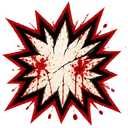 Defender Down (Pow) Defender Down (Pow) | 1 | The Stooge goes down and rolls armour. |
- Chain push: if a miniature is in the way it is pushed forward as in Blood Bowl. At the edges of the pitch it ends up in the crowd (crowd surf).
- Goon: when the Goon hits the Stooge, he moves only 1 square, whatever the result.
- Second Hit: a separate action, like Block or Blitz, with the usual Blood Bowl rules for actions. Once per arc, a Whacker with the TTM skill who has not yet been activated this turn may make a Second Hit: a Touch on the Stooge, resolved like any other Touch. It can only be declared when the Stooge is in the Casualty state, and it does not use the team's Blitz.
- Armour: the miniature's real AV is used, with Stunty and other traits (the cap he wears counts for nothing, unless you use the Stooge helmets extra rule). An armour roll that beats the AV worsens the Stooge's state by one step (see Stooge state and scoring).
Defence
Defenders try to stop the attack using the Blood Bowl rules for Block and Blitz, with two prohibitions.
Never the Stooge
They cannot block or blitz him, not even voluntarily.
Immune to chain pushes
If a defender pushes an attacker and a valid square contains the Stooge, that square cannot be chosen. If no other square is available, the attacker stays where he is.
Defenders therefore hit the Whackers, the Goon and the Cuddler, who are pushed 1 square in the direction the defender chooses. Defenders may also stand in the Stooge's path: he pushes them away with a chain push.
Stooge state & scoring
The Stooge never leaves the pitch and is never removed. His state only decides the points on arrival, and it can only get worse. The Stooge is worth at most 3 points, plus 2 more if the Cuddler catches him.
- Landing: after the TTM the Stooge starts Stunned (the starting state, worth 3).
- Worsening: every armour roll on the Stooge that beats his AV moves him to the next state: Stunned, KO, Casualty. Casualty cannot get worse.
- Catch bonus: +2 points if the Cuddler catches the Stooge (see next section).
Cuddler & catch
A team scores as soon as the Stooge enters the destination end zone, even in the middle of a push. The Cuddler's catch, if any, is resolved immediately afterwards.
- Catch: if the Stooge enters the Cuddler's own square (and he is standing), the Cuddler attempts a catch with the Blood Bowl rules, whatever the Stooge's state. If he succeeds, the team scores 2 extra points, unless the Cuddler has Throw Team-Mate and the attacker goes for The Ding-Dong instead.
- Never pushed by the Stooge: the Stooge does not push the Cuddler, he only triggers the catch.
- The Cuddler can be displaced by enemy blocks, even out of the end zone. In that case he must move back into it.
- Square held by a defender: the defender attempts to catch the Stooge with the Blood Bowl rules. If he succeeds, there is no score. If he fails and the Stooge bounces (fumble), the team scores only if he ends up inside the end zone.
The Ding-Dong
Keep the points, or go for the ding-dong.
When the Cuddler catches the Stooge, and only if the Cuddler has Throw Team-Mate, the attacker must choose at once, before anything else happens:
| Choice | What happens | Points |
|---|---|---|
| Keep the catch | Nothing else happens. The team scores the extra points of the catch. | +2 |
| Go for the ding-dong | The Cuddler gives up the 2 points and throws the Stooge back at the defenders. If the Stooge lands on a defender, the team scores 3 points instead. If not, it scores nothing extra. | +3 or 0 |
How the Ding-Dong works
- The throw: the Cuddler throws the Stooge with the normal Throw Team-Mate rules, as for the opening throw: the range is measured from the Cuddler's square (Quick or Short, the only ranges a team-mate can be thrown), then the PA roll, scatter and fumble. Weather affects it as it affects the opening throw. Team re-rolls, Loner and Always Hungry work as usual.
- The target: before measuring the range, the attacker chooses any opposing miniature within Short range of the Cuddler as the target of the throw. If there is none, the ding-dong cannot be tried and the Cuddler keeps the catch.
- Ding-dong! if the Stooge lands on the square of any defender, the target or not, he has hit the bell: the defender is Knocked Down and rolls armour as usual, and the team scores 3 points instead of the 2.
- If it goes wrong: if the Stooge lands anywhere else, if the throw fumbles or if the Cuddler eats him, the extra points are lost, and so is the catch bonus.
- The arc ends in any case. The points for the Stooge's state do not change, whatever happens to him in flight. After the landing he lies prone and rolls armour as in Blood Bowl: in a league that can hurt him (see Injuries in a league), in a one-off game it changes nothing, because everybody is back on his feet at the next arc.
- SPP: in a league, a ding-dong that lands on a defender earns the Cuddler 1 SPP more, on top of the 2 SPP of the catch (see Advancement).
- When to go for it: there is no rule on that. The coach decides, in friendly games and in the Throwback Nights alike, and both coaches are free to cheer, boo or throw things.
- Table custom: keep a small bell on the table (the will do nicely), and ring it when the Stooge lands on a defender. Nobody has to, and everybody does.
A big Cuddler is a choice. A miniature with Throw Team-Mate costs 115-140K, so a Cuddler who can go for the ding-dong is an expensive Cuddler. A team that does not have one simply keeps the catch.
Out of bounds
If a hit pushes the Stooge over a side boundary, or back past his own starting end zone, the crowd and the sideline throw him straight back in. He stops on the square he left from and his state worsens by one step.
End of arc & the match
- Arc: the attacker has up to eight turns to score, as in a Blood Bowl half (nine after a Time-Out event). The arc ends when the Stooge scores, or after the attacker's eighth turn if he has not: in that case the arc scores 0.
- Next arc: after every arc, scored or not, positions reset and roles swap. The team that attacked now defends and vice versa, and the new attacker chooses the wide zone. The first attacker is decided in the pre-match sequence (coin toss).
- Winning the match: the first team to reach 10 points wins, but only once both teams have attacked the same number of times. The match therefore ends at the end of an arc after which both teams have made the same number of attacks and at least one has 10 or more points. The team with more points wins. If they are tied, the match goes on one more pair of arcs (one attack each), repeated until the tie is broken.
- Interval: after both teams have made 4 attacks, and again after every further 4 attacks each, there is an interval. Team re-rolls and inducements that are used once per interval refresh.
- Choice of lane: the attacker chooses the wide zone he prefers. It changes nothing in the rules, so the choice is purely flavour.
- KO and Casualty: in one-off games, at every new arc everyone is back on his feet: each team has a wizard who puts them back on the pitch. In a league the wizard does not help: injuries work as in Blood Bowl (see League play).
Inducements
Teams may buy inducements from the same 400K budget as re-rolls. There is no limit to how many a team buys, but only one of each type. Each inducement can be used once per interval (it refreshes at every interval), unless stated otherwise. Inducements are for attack only: they are used during the team's own turns, on its own Stooge. Permanent staff are not inducements: see Sidelines. Inducements can also be bought with Petty Cash in the Pre-Match sequence (step 3); in a league that is the only way to buy them.
| Inducement | Effect | Cost |
|---|---|---|
| Ointment | Before a Touch, declare the Ointment: that Touch moves the Stooge 1 square further. | 25K |
| Sweeper | After a Touch, if a Whacker or the Goon is adjacent to the Stooge, the Stooge moves 1 more square straight ahead (not diagonally). Once per arc, not once per interval. | 45K |
| Ice Medic | Moves the Stooge one state better (Casualty to KO, KO to Stunned). Stunned is the best state, never healthy. | 80K |
| Padding | Re-roll one armour roll against the Stooge; the second result stands. | 30K |
| Skip's Call | +1 to the PA roll of the opening throw. | 10K |
| Hurry Hard! | A Whacker makes one Touch as if with a Blitz, without spending the team's single Blitz of the turn. | 50K |
| Soft Mat | +1 to the Cuddler's catch roll. | 30K |
Sidelines
Sidelines are the permanent staff who work the touchline for a team: the people who prepare the lane, call the time-outs, keep the paperwork in order and keep the crowd loud. All of them belong to the Touchline Guild, an old and stubborn guild that lends its members to the teams and charges a fee for it, which is why a team has a budget of its own for them. They are not inducements. An inducement is bought for a match; a sideline belongs to the team and stays with it. Each team has a sideline budget of 80K, separate from the 400K of team building. It can only be spent on sidelines, and unspent gold is lost. A team may hire only one of each sideline. Sidelines never count towards Team Value, and they never get hurt: the touchline is the one safe place in Skurling.
| Sideline | Effect | Cost |
|---|---|---|
| Pebbler | Once per match, after the Pebblemuck has been rolled, re-roll either of its two rolls (the 2D6 or the D6); the second result stands. | 30K |
| Skip | Once per match, the Skip calls a Time-Out: the attacker has one extra turn in that arc. It is added to any other extra turn. | 25K |
| Brushmaster | Once per arc, when an enemy block would push one of your Whackers or the Goon, the Brushmaster brushes the square clean: the push is ignored and the miniature stays where it is. The rest of the block is resolved as usual. | 30K |
| Scribe | Once per match, after a Landing event has been rolled, the Scribe finds a clause that allows you to re-roll it; the second result stands. Either team's Scribe may do this. | 20K |
| Drillmaster | Once per match, at the start of an arc, the Drillmaster makes the team go again: your team gets a free team re-roll for that arc. It follows the usual rules (at most one team re-roll per turn) and is lost if unused. | 25K |
| Mob | Your team adds 1 to its Fan Factor, from the Fans step on. | 15K |
In a league, a new team starts with the 80K sideline budget in addition to its 1000K. Later sidelines are hired, or dismissed, in the Hire, fire and retire step of the post-match sequence, with Treasury gold, at the same prices.
League play
Skurling is better over a season.
A league is a series of matches in which the teams keep their rosters from one match to the next, and grow. League play follows the Blood Bowl League Play rules (the post-match sequence, advancement, injuries and hiring), with the changes below. Anything not mentioned here works as in the Blood Bowl rulebook.
League roster sheet. A larger sheet for leagues: ten roster lines with a free Role column to fill in by hand, SPP and injury tracking, Treasury, Dedicated Fans and a league match log. Download the league PDF
The league roster
- Starting team: built as in Team building, but with a starting budget of 1000K (enough for ten miniatures and a few re-rolls), the same five-miniature constraints for the fielded team, and any unspent gold going to the Treasury instead of being lost. Inducements are not bought at team building: in a league they come from Petty Cash or the Treasury before each match (Pre-Match, step 3) and last for that match only.
- Roster size: up to 10 miniatures. Only five play in each match. The five fielded miniatures (exactly one Right Stuff, at least one Whacker with Throw Team-Mate) are declared in the pre-match sequence and stay the same for the whole match. The roster may hold several Right Stuff miniatures, as spare Stooges.
- Roles: roles are still assigned at the start of every arc, so the roster sheet has a free Role column rather than fixed roles.
- Team Value (TV): the cost of every miniature that is not missing the next match, plus the value of their advancements, plus the cost of the team re-rolls. Inducements never count.
- No Star Players. The spotlight belongs to the benchwarmers. The only guests are the Headliners that a sponsor may lend for a match.
Substitutes and Journeymen
A miniature that is removed from the pitch (see Injuries in a league) may be replaced, at the start of the next arc, by any miniature on the roster that is not already on the pitch. Roles are reassigned at that moment as usual. If the roster has nobody left, or no Right Stuff miniature left for the Stooge, the team takes on Journeymen: Linemen from the roster the Goon was taken from (for the Stooge, the cheapest Right Stuff position of any roster), each with Loner (4+). Journeymen earn no SPP and leave after the match. A team that cannot even field its five miniatures at the start of a match does the same. In one-off games there are no Journeymen.
Post-match sequence
- Winnings. Each team receives (FA / 2, rounded up + arcs your team scored in + 1 if your team won) × 10K, added to its Treasury. (The Blood Bowl bonus for not stalling is replaced by a bonus for winning.)
- Update Dedicated Fans. The winner rolls a D6: if the result is equal to or higher than its Dedicated Fans, they go up by 1 (maximum 7). The loser rolls a D6: if the result is lower than its Dedicated Fans, they go down by 1 (minimum 1).
- Sponsors. Each team may look for a sponsor, or renew the ones it has: see Sponsorship.
- Injuries. Apply the results recorded during the match: miniatures that are Seriously Hurt miss the next match (MNG), those with a Serious or Lasting Injury take its effects, and the Dead leave the roster.
- Player advancement. Spend SPP, as described in Advancement.
- Hire, fire and retire. Hire new miniatures (up to 10 on the roster) and buy extra team re-rolls at double cost, as in Blood Bowl. Injured miniatures may be dismissed or temporarily retire; unwanted ones may be dismissed. Sidelines are hired or dismissed here too, at the prices in Sidelines.
- Expensive Mistakes. A team whose Treasury holds 100K or more rolls a D6 on the Blood Bowl Expensive Mistakes table, exactly as in Blood Bowl.
- Update Team Value. Recalculate the Team Value, as described under The league roster.
Injuries in a league
In a league, injuries work as in Blood Bowl. A miniature that is knocked out or suffers a Casualty goes off the pitch and is out of play, to the KO box or the Casualty box, which are in the centre field, as there are no dugouts. KO'd miniatures try to recover at the end of each arc, as in Blood Bowl (D6, 4+). Casualties stay out for the rest of the match. A coach may replace a miniature that is out of play with another one from his roster at the start of the next arc (see Substitutes and Journeymen above).
Roll a D16 for every Casualty when it happens, as in Blood Bowl, and note the result on the roster sheet. It takes effect after the match (Injuries, step 4 of the post-match sequence). Regeneration and other skills work as in Blood Bowl. There are no Apothecaries: the Federation's wizard is not for hire.
The Stooge never leaves the pitch. For the Stooge, KO and Casualty are still the scoring states of Stooge state and scoring, and they never take him out of the arc. But when the Stooge enters the Casualty state, make a Casualty roll for him at once (once per arc). If he is Dead, the arc ends immediately and scores 0 points, and a replacement Stooge is fielded in the next arc. In any other case the sideline puts him back on his feet, he returns, and, much against his will, gets thrown again in the next arc. All this happens before any scoring: if the Stooge enters the Casualty state and the end zone in the same push, the Casualty roll comes first, and a Dead Stooge does not score.
| D16 | Result | Effect |
|---|---|---|
| 1–8 | Badly Hurt | No lasting effect. |
| 9–10 | Seriously Hurt | Misses the next match (MNG). |
| 11–12 | Serious Injury | Niggling Injury, and MNG. |
| 13–14 | Lasting Injury | -1 to a characteristic (as in Blood Bowl), and MNG. |
| 15–16 | Dead | Removed from the roster. |
League table
A win is worth 3 league points and a loss 0. Matches cannot be drawn (see End of arc). Teams level on league points are ranked by the difference between match points scored and conceded.
Sponsorship
Somebody is paying for the brooms.
A team that draws a crowd attracts sponsors: bakeries, broom-makers, bell-founders, the odd suspicious wine merchant, all of them members of the Patrons’ Consortium. Sponsorship is a league rule: one-off games have none. A sponsor does not give gold. It gives something to use on the lane: a tool, a member of staff or, with luck, a guest champion.
Finding a sponsor
In the post-match sequence, right after the Dedicated Fans are updated, each team may look for a sponsor. Roll a D6 and add the team's Dedicated Fans (as just updated), plus 1 if the team won the match. On an 8 or more a sponsor makes an offer. A team looks for one sponsor per match, and may have at most two sponsors at a time.
What the sponsor offers
Roll a D6 on the table. The coach may always take something lesser than what comes up, never something better.
| D6 | Offer | What you get |
|---|---|---|
| 1–3 | A tool | One inducement of your choice, free, at every match, for as long as the sponsor lasts. It counts as that inducement for the “only one of each” limit: you cannot choose one you already have from another sponsor, and you cannot buy it again. |
| 4–5 | A sideline | One sideline of your choice, for as long as the sponsor lasts. It does not use the 80K sideline budget, and it is never an extra copy: you cannot choose a sideline you already have. |
| 6 | A Headliner | A guest champion who plays your next match only (see below). |
- Downgrading: a Headliner may be turned into a sideline or a tool, and a sideline into a tool. Decide at once, before anything else.
- Nothing left to choose? If the sideline that comes up is one you cannot take (you have all six, or they are all sponsored), it becomes a tool.
- The sponsor has a name. Invent it, and write it on the roster sheet with the gift it gives. The Federation recommends bad puns.
Headliners
A Headliner is a guest champion lent by the sponsor: a famous name on the bill of one night. Choose one from the list of Headliners.
- Next match only. The Headliner is declared with the five fielded miniatures in the pre-match sequence, takes the place of one of them, and leaves after the match, whatever happens.
- On top of the roster. A Headliner does not use one of the 10 roster places. A team has one Headliner at a time, and it does not count as one of its sponsors.
- Team Value: for that match the Headliner adds 100K to the team's Team Value, so the other team may get Petty Cash for it.
- No scars, no SPP: a Headliner earns no SPP and its injuries are ignored, like a Journeyman's.
- The fielded five still need exactly one Right Stuff miniature and at least one Whacker with Throw Team-Mate: a Headliner may fill one of those places.
Ending a sponsorship
- When you like. A coach may end a sponsorship whenever he wants, and loses the tool or the sideline with it.
- Between seasons. Before the first match of a new league season, roll a D6 for every sponsor and add the team's Dedicated Fans. On an 8 or more the sponsor stays for the new season; otherwise it leaves, and so does its gift.
Headliners
Famous names on the bill, for one night only.
Headliners are the guest champions of Skurling, and they all belong to the Marquee Guild, the guild of the famous. They cannot be hired or bought: a team gets one only through a sponsor (a 6 on the sponsor's offer roll), for its next match only. Each one counts 100K of Team Value for that match. The rules for lending, fielding and leaving are in Sponsorship.
Each Headliner has a reference race, taken from the Blood Bowl rosters, which tells you what kind of miniature to look for. It is only a suggestion: use any miniature you like for a Headliner, as for every other Skurling miniature. Their stats follow the Blood Bowl layout, and their skills are the Blood Bowl ones, with the usual rules.
| Headliner | Race | Role | MA ST AG PA AV | Skills | Cost |
|---|---|---|---|---|---|
| Pip Featherweight | Halfling | Stooge | 7 2 2+ 4+ 8+ | Dodge, Right Stuff, Stunty, Sure Feet | 100K |
| Gus Anvil | Dwarf | Stooge | 5 3 3+ 5+ 9+ | Dodge, Right Stuff, Thick Skull | 100K |
| Gorga Longarm | Ogre | Whacker with Throw Team-Mate | 5 4 4+ 3+ 10+ | Bone Head, Loner (4+), Strong Arm, Thick Skull, Throw Team-mate | 100K |
| Marge “The Mop” Brannock | Norse | Whacker | 6 4 4+ 5+ 9+ | Block, Dauntless, Guard | 100K |
| Tilly Quickbroom | Skaven | Goon | 8 3 3+ 4+ 8+ | Dodge, Jump Up, Sprint, Sure Feet | 100K |
| Dolores Safehands | Human | Cuddler with Throw Team-Mate | 5 3 3+ 4+ 9+ | Catch, Diving Catch, Loner (4+), Nerves of Steel, Throw Team-mate | 100K |
On the bill
- Pip Featherweight. Lands like a rumour: light, quick and very hard to hit.
- Gus Anvil. Has been thrown many times and is not impressed.
- Gorga Longarm. Throws far and apologises to nobody.
- Marge “The Mop” Brannock. Cleans the lane, and everything on it.
- Tilly Quickbroom. Gets there first and holds the door.
- Dolores Safehands. Catches anything, then sends it back with interest.
- A first six. More Headliners will come, with their illustrations, like the historical teams in the Miniatures window.
- The fielded five. A Headliner takes the place of one of them: Pip Featherweight and Gus Anvil have Right Stuff, so they may be the Stooge, and Gorga Longarm and Dolores Safehands have Throw Team-Mate, so they may throw him. The team still needs exactly one Right Stuff miniature in the five.
- Who may be the Cuddler? Dolores Safehands has Throw Team-Mate: she can go for the ding-dong after a catch.
Advancement
Miniatures earn Star Player Points (SPP) in league matches and spend them in the post-match sequence. Skurling has its own list of ways to earn them.
| Event | SPP | Goes to |
|---|---|---|
| Stooge scores (enters the end zone) | 3 | the Stooge |
| Final Touch: the Touch that moved the Stooge into the end zone | 2 | the hitter |
| Superb Throw: the opening throw lands safely on the target square (no scatter, no fumble), once per arc | 1 + 1 | thrower + Stooge |
| Cuddler catches the Stooge | 2 | the Cuddler |
| Ding-dong lands on a defender | 1 | the Cuddler, on top of the 2 for the catch |
| A defender catches the Stooge | 2 | the defender |
| Casualty caused by a Block action against an opponent | 2 | the blocker |
| Most Valuable Player (one per team per match) | 4 | the MVP |
SPP are earned only by the fielded miniatures, and only in league matches. For the MVP, the coach numbers his five fielded miniatures 1 to 5 and rolls a D6, re-rolling a 6.
Spending SPP
The costs are those of Blood Bowl. A miniature chooses its skills from the categories of its position, Primary or Secondary, as in Blood Bowl. If a characteristic result is skipped, a Primary or Secondary skill can be chosen, but the SPP cost is that of a random characteristic.
| Level | Random Primary | Chosen Primary | Chosen Secondary | Random characteristic |
|---|---|---|---|---|
| 1st | 3 | 6 | 10 | 14 |
| 2nd | 4 | 8 | 12 | 16 |
| 3rd | 6 | 12 | 16 | 20 |
| 4th | 8 | 16 | 20 | 24 |
| 5th | 10 | 20 | 24 | 28 |
| 6th | 15 | 30 | 34 | 38 |
Team Value increases
Each advancement raises the miniature's value, and so the team's TV:
| Advancement | Value |
|---|---|
| Primary skill | +20K |
| Elite Primary skill | +30K |
| Secondary skill | +40K |
| Elite Secondary skill | +50K |
| +1 AV | +10K |
| +1 MA or +1 PA | +20K |
| +1 AG | +30K |
| +1 ST | +60K |
Throwback Nights
One night, one trophy, no helmets.
Once a year, after the Bonspiel, the Federation holds Throwback Night: a one-night tournament in which teams play Skurling as it was played before the helmets (see Eras of Skurling). It is quick, loud and a bit unfair, and it is built to be played in one evening. The rules below add to the normal rules of the game, and anything not mentioned here works as usual.
Teams
- Teams are built as in Team building: five miniatures and 400K, plus the 80K for Sidelines. Inducements are bought at team building only: there is no Petty Cash and no Treasury.
- Each team brings its Gaffer, and is encouraged to field historical miniatures: players in wool and leather, with no armour or spiked pads.
Throwback Kit
For the whole tournament every match uses these rules:
- The old ice. The Pebblemuck is not rolled on the 2D6 table. Every match is played on Raw Ground: roll only the D6 for its Attribute, and re-roll Astrogranite and Solid Stone, which did not exist in the old days.
- The Gaffer rings the bell. The Gaffer's bell opens every arc, and the team that attacks places its Gaffer beside the lane, as usual.
Format
- With 4 to 8 teams everybody plays everybody once. With more, play three Swiss rounds, and the top two teams meet in the final.
- Throwback matches are short. The first team to reach 6 points wins, after both teams have attacked the same number of times. There is no interval. A tie is broken as in a normal match.
- A match lasts at most an hour. If time runs out, the match is decided on the points scored at the end of the last complete round of arcs; if still level, the Gaffers toss a coin.
Points and trophies
- A win is worth 3 points, a loss 0. A team whose five miniatures and Gaffer are all in historical dress earns a Dress bonus of 1 point per match, whatever the result. The opposing coach has the last word on what counts as historical dress.
- Teams are ranked by tournament points, then by the difference between match points scored and conceded.
- The winner takes the Golden Broom. The last team takes the Wooden Stooge, a leather cap nailed to a plank, with the Federation's sincere congratulations.
Extra rules
For when the basic game is not quite silly enough.
Everything in this group is optional: an extra rule is only used if the league, the tournament or the two coaches agree to use it, and the game is complete without them. They add colour, a little chaos and a few more things to argue about. Each of them is marked as an extra rule wherever the rest of the book mentions it.
- Stooge helmets: once per match, a team may dress its Stooge in something more interesting than his usual cap.
- Seasonal weather: four weather tables, one for each season, to use instead of the standard Weather table.
- Grounds: weather tables for particular grounds, to use instead of the standard Weather table. Two so far, more to come.
The Throwback Nights use none of them: they are played as it was done before the helmets, and the weather on the night is the weather of the night.
Stooge helmets
Every hat has a story, and most of them are lies.
The Stooge always wears a cap: it is the one his miniature is wearing, it counts for nothing, and his armour is his own AV. With this extra rule, once per match, he may put on something more interesting. This is an extra rule.
- Once per match, per team. The attacker may declare a special helmet for his Stooge before the opening throw of an arc, once per match. The other team may do the same when it attacks.
- Choose or roll. The coach may choose any helmet from the table, and it lasts for that arc. Or he may roll a D8 instead, and the Stooge refuses to take it off: a rolled helmet lasts for the whole match.
- It is free. No gold, no Petty Cash. The Federation has plenty of hats.
- Inducements still work. Padding and the Ice Medic work as usual with any helmet.
- Not in the Throwback Nights, which are played before the helmets.
| D8 | Helmet | Effect |
|---|---|---|
| 1 | Bucket Helm | A cooking pot, still warm. +1 to the Stooge's AV, but a Push Back moves him 2 squares instead of 3. |
| 2 | Feather Cap | Light as a rumour. +1 to the PA roll of the opening throw (and of the ding-dong throw), but -1 to the Stooge's AV. |
| 3 | Wooly Bonnet | Knitted by somebody's grandmother, which is the best armour there is. The first armour roll against the Stooge in each arc has -1. |
| 4 | Big Bobble | A very visible pompom. +1 to the Cuddler's catch roll, but -1 to the PA roll of the opening throw (the thrower keeps laughing). |
| 5 | Pie Dish | The crowd loves it. If the Stooge enters the end zone Stunned, he is worth 4 points instead of 3, but every armour roll against him has +1. |
| 6 | Cork Cap | He floats. When the crowd throws him back in (see Out of bounds), his state does not get worse, but a Both Down moves him 0 squares instead of 1. |
| 7 | Lead-lined Lid | Nobody asked who lined it. +2 to the Stooge's AV, but every Touch moves him 1 square less (minimum 1). |
| 8 | The Gaffer's Lucky Hat | The Gaffer lends his own. The coach chooses any one of the other seven helmets. |
A +1 to an armour roll is bad news for the Stooge (the roll has to beat his AV), and a +1 to his AV is good news.
Seasonal weather
Nice, with a chance of Stooge, in every season.
Skurling is played in every season, and the weather has opinions about each of them. This is an extra rule: the Federation keeps four optional weather tables besides the standard one, one for each season. They are rolled on 2D6, like the standard Weather table, and replace it.
- Who chooses. The commissioner of a league may fix one season for a whole league season (a Spring League, a Winter League), and the two coaches of a single match may agree on one. If nobody chooses, the standard Weather table is used.
- Where it is used. Everywhere the rules say “roll on the Weather table”: the pre-match sequence and the Changing Weather Landing event use the table in use.
- The Pebblemuck is not affected: it is still rolled as usual, because the lane is prepared whatever the sky is doing.
- One table at a time. A seasonal table and a ground table are never used together: the match uses one of them.
Spring: The Thaw
| 2D6 | Weather | Effect |
|---|---|---|
| 2 | Morning Dew | The lane is slippery. Rush rolls fail on a 1 or a 2 during the first turn of every arc. |
| 3 | Hay Fever | The thrower sneezes. -1 to the PA roll of the opening throw (and of the ding-dong throw). |
| 4–10 | Mild, with a Chance of Lambs | No effect. Keep an eye on the sheep. |
| 11 | Muddy Thaw | The mud holds on to everything. A Push Back moves the Stooge 2 squares instead of 3. |
| 12 | Spring Gale | A gust blows the Stooge about. At the start of each of the attacker's turns he is blown 1 square in a random direction (scatter template). If that square is off the pitch or holds a miniature, he stays where he is. |
Summer: The Dog Days
| 2D6 | Weather | Effect |
|---|---|---|
| 2 | Heat Wave | After set-up of each arc, each coach rolls a D3+1. That many random miniatures of his team on the pitch (never the Stooge) have -1 MA until the arc ends. Hats are recommended. |
| 3 | Sunburnt Stooge | The Stooge is as red as a lobster and just as tender. +1 to every armour roll against the Stooge. |
| 4–10 | Glorious | Bring a hat, bring a pie. No effect. |
| 11 | Thunderheads | The sky growls. -1 to every catch roll. |
| 12 | Lightning Storm | At the end of each team's turn, its coach rolls a D6. On a 1 lightning knocks down a random miniature of his team on the pitch (never the Stooge). |
Autumn: The Falling Leaf
| 2D6 | Weather | Effect |
|---|---|---|
| 2 | Leaf Slide | The lane is a carpet of wet leaves. +1 to every armour roll against a miniature that falls over or is knocked down (the Stooge is not affected). |
| 3 | Early Dusk | The Federation stops for tea. The attacker has 7 turns in this arc instead of 8 (8 after a Time-Out). |
| 4–10 | Golden Leaves, Soup in the Air | No effect. Somebody is making soup. |
| 11 | Autumn Rain | -1 to every catch roll. |
| 12 | Strong Winds | The wind catches the flying Stooge. After the opening throw (and the ding-dong throw) lands, he scatters once more with the scatter template. |
Winter: The Long Frost
| 2D6 | Weather | Effect |
|---|---|---|
| 2 | Black Ice | The Stooge slides as if he were born to it. Every Touch that moves him moves him 1 square more, but every armour roll against him has +1. |
| 3 | Hard Frost | The ground has no sympathy. +1 to every armour roll against the Stooge. |
| 4–10 | Crisp and Clear | The ice would be proud. No effect. |
| 11 | Heavy Snow | Everybody wades. -1 MA for every miniature (minimum 1). |
| 12 | Blizzard | As in the Weather table: -1 to the PA roll of the opening throw (and of the ding-dong throw), and Rush rolls fail on a 1 or a 2. |
Grounds
Every ground has its own weather, and its own opinions.
Some grounds have a weather of their own, whatever the season says. This is an extra rule. A ground table works like a seasonal one: it is rolled on 2D6 and replaces the standard Weather table. Two grounds are known so far, the home grounds of the two historical teams, and the Federation expects more.
- Who chooses. By custom, a match played at the home ground of a club uses that ground’s table. The commissioner of a league or the two coaches may also choose a ground for any match, as they would a season: see Seasonal weather.
- Where it is used. As for the seasons: the pre-match sequence and the Changing Weather Landing event use the table in use. The Pebblemuck is rolled as usual.
- One table at a time, either a ground or a season.
The Loch (Strathcraig)
| 2D6 | Weather | Effect |
|---|---|---|
| 2 | Something in the Loch | After set-up of each arc, each coach rolls a D6. The lower roller (both on a tie) places a random miniature of his team on the pitch (never the Stooge) prone. Nobody has ever seen what it is. Nobody wants to. |
| 3 | Lake Mist | You can hardly see the end zone. -1 to the PA roll of the opening throw (and of the ding-dong throw). |
| 4–10 | The Loch Behaves | Dark, deep and calm. No effect. |
| 11 | Cold Spray | The wind brings the loch with it. -1 to every catch roll. |
| 12 | Loch Overflow | The loch is on the lane. Rush rolls fail on a 1 or a 2, and a Push Back moves the Stooge 2 squares instead of 3. |
The Moor (Dunmoor)
| 2D6 | Weather | Effect |
|---|---|---|
| 2 | Hungry Bog | After set-up of each arc, a random defender is stuck in the bog: he cannot move until the start of the attacker's third turn. |
| 3 | Peat Smoke | -1 to every catch roll. |
| 4–10 | Damp, Dark and Dreary | As ever. No effect. |
| 11 | Moor Fog | -1 to the PA roll of the opening throw and -1 to every catch roll. |
| 12 | Will-o’-the-Wisps | Little lights lead the Stooge astray. At the end of each of the attacker's turns, roll a D6: on a 1 he is led 1 square in a random direction (scatter template). If that square is off the pitch or holds a miniature, he stays where he is. |
Origins
The Old World Skurling Federation, and the god who keeps us sweeping.
Every Blood Bowl player knows Nuffle, the god of chance and consequences, and the NAF that keeps his game honest. Fewer know that in the cold north of the Old World there is a quieter, louder, much stranger devotion: the Old World Skurling Federation (OWSF), keeper of the rules and guardian of the Stooge.
The OWSF is no upstart. It calls itself the Mother Club, the oldest body of anyone who ever slid a rock along ice and shouted at it. It sanctions every bonspiel, certifies every pitch, and has never once admitted that the sport began as an accident.
How a rock became a halfling
Long before Skurling, Dwarf and Norse herders played the Roarin' Game on frozen lochs: a polished stone of granite, a team of sweepers with brooms, and a skip bellowing orders from the far end. The granite came from a single crag in the Sea of Claws, the Craig, and no other rock would do.
The legend says that in a tavern near the Craig, a Goblin who had lost a bet was used in place of the stone. He slid magnificently. The sweepers, who had been sweeping for years without ever being thanked, discovered that hitting him was far more satisfying. The Federation was founded the next morning, mostly to settle the argument about who was allowed to hit whom.
Where the name comes from
The first rulebook was drafted by Skaven. Nobody else could be trusted to produce so many pages, so quickly, and with so many small clauses nobody would ever read. A clan of clerks from Skavenblight wrote down the rules, struck a deal with the Federation to publish them, and gave the sport its name: Skurling, with a rat's hiss in front. They have claimed ever since that they invented it. The Federation lets them: it is easier than checking.
The first “official” Stooge, the records add, was a Skavenslave who had been told it was a promotion.
From ice to turf
For generations the Roarin' Game lived and died with the weather. Every spring the lochs thawed, the stones sank, and the sweepers went home to sulk. Then came the Long Thaw, a spring so warm that the ice never returned, and the Federation faced ruin.
The answer was found in the off-season, on the empty Blood Bowl pitches of the Old World. The grass was wide, the mud was slick enough to slide on if you were thrown with conviction, and the crowds were already there, bored and armed with opinions. The Federation sent an embassy to Nuffle's own stadiums, and after some negotiation, and a quantity of gifts the records do not describe, a deal was struck.
Skurling would be played on the pitch, but only in the two wide zones, along the sidelines. The centre of the field belongs to Nuffle, and no Stooge has ever been thrown across it. The brooms stayed, but with no ice left to scrub they found a better use, and the sweepers became Whackers. Some say it was the best thing that ever happened to the sport. The Stooges disagree.
The brooms fall silent
At first the brooms were used exactly as the sweepers had always used them, only now the ground in front of the Stooge was mud and not ice, and the broom found a new target. Sweepers walked beside the flying Stooge and struck him with the broom to keep him moving. It worked remarkably well, and it ruined a great many brooms.
The brooms did not last. They snapped, they stuck in the turf, and the Federation grew tired of buying new ones. Within a few seasons the Whackers had set them aside and were pushing the Stooge forward with their own hands, shoulders and boots, which broke less often and hurt considerably more. The broom survives only as a badge of office, and as the thing Whackers shake at the sky when the Stooge goes the wrong way.
The game behind the game
Today Skurling is played on the very pitches where Blood Bowl lives, and the players are Blood Bowl players. In the long pauses between matches, in the interval, before the stadium fills or after the crowd has gone home, someone fetches a broom and a volunteer and a game begins.
It is mostly a game of the benchwarmers. The star Blitzers and Linemen who play every match have little time for it. The reserves who rarely see the pitch have all the time in the world, and nothing to lose. Over the last few seasons it has caught on in every locker room of the Old World: teams keep a Stooge on the roster just for it, and more than one coach has discovered, to his surprise, that his Skurling team is better supported than his Blood Bowl one.
Eras of Skurling
How the game has dressed over the centuries.
The ice years
In the days of the Roarin' Game nobody wore anything that could be called equipment. Sweepers wore wool, hobnailed boots and whatever their grandmothers had knitted; skips wore a hat, so that people could find them. The Stooge, once the stone had been replaced by a Goblin, wore a leather cap, mostly because the Goblin insisted.
The turf years
On the Blood Bowl pitches the first padding appeared: a boiled-leather jerkin, a felt cap stuffed with straw and, for the Whackers, the broom, which was both a tool and a badge of office. Armour was forbidden. The Federation's first rule on the subject, drafted by Skaven clerks, runs to a page and a half of exceptions.
The benchwarmer years
Today Skurling is played by Blood Bowl players on Blood Bowl pitches, and they bring the same kit they wear for the real game: helmets, shoulder pads, gauntlets and spikes on everything, borrowed from the equipment room and returned, mostly, in the same condition. The Federation approves, for the simple reason that the Stooge's survival rate has improved from “hopeful” to “occasional”.
Throwback nights
Every year, at the Bonspiel, some teams play a throwback match in historical dress: wool and hobnails, leather caps, brooms. It is considered an honour. Nobody has yet been able to explain the rules, because the Federation is still looking for them.
The old rivals
Two teams, one very long argument.
Every sport needs a rivalry, and Skurling has two teams that have been shouting at each other since before the rules were written down. They are the Strathcraig Hammers and the Dunmoor Dead Ends, and between them they hold the oldest grudge in the Federation.
The Strathcraig Hammers
The Hammers come from the loch country, where the granite comes from. They are the pride of the Mother Club: solid, stubborn and always dressed in moss green and ochre, as if the hills had decided to take up sport. Their emblem is the wooden mallet, the old “hammer” of the Mother Club, and a leather Stooge's cap hanging from its handle, which they claim is a trophy and which everyone else suspects is a former Stooge. They have won more Golden Brooms than anybody, and they will tell you so, in order, with dates.
The Dunmoor Dead Ends
The Dead Ends come from the bogs beyond the moor, and they turned up one spring in plum and slate and patchwork wool, none of it matching, and asked to play. Nobody had the heart, or the paperwork, to say no. Goblins, zombies and the occasional troll, they are the team the Federation has never managed to get rid of, and the one the crowd likes best. They have lost more matches than any team in history, and their motto is “Still Playing”. They hold the Wooden Stooge permanently, on a shelf, with a candle.
The Throwback Night grudge
Every year, at the Throwback Night, both teams turn up in their old dress, and every year the match between them is the one the Federation sells tickets for. The Hammers play the lane as if it were holy ground; the Dead Ends play it as if it were somebody else's problem. Nobody knows who started it. Both clubs have a sealed envelope, in the Mother Club's cellar, with the answer. Neither has dared open it.
Sweepuh, god of the broom
Where Nuffle is the god of the game, Sweepuh is the god of the push. Scholars note that the name is "sweeper" worn down by centuries of shouting, exactly as "Nuffle" is what is left of a very old word nobody dares to spell.
Sweepuh has no face and no body, only a broom, and the broom is never still. He is the one who, unseen, scrubs the ice ahead of the stone so that it goes further, straighter, faster. Every Whacker who lands a good Touch says a quick word to him first; every Whacker who falls over says a longer one afterwards.
Hurry hard!
Whatever you are doing, do it with more conviction. The god dislikes hesitation, especially in Whackers.
The Stooge volunteered
No one is thrown against their will. Officially. The Federation keeps a very large form for this.
Hold the line
The hog line is sacred. Whoever does not cross it is a coward; whoever is thrown across it is a saint.
Be soft where it counts
Even a stone needs a landing. This is why every team keeps a Cuddler.
The Federation today
How a very old club ended up running a very new sport.
Nobody ever voted to put the Old World Skurling Federation in charge of the game. It was simply there first, which in the Old World is the same thing. When the ice melted and the sport moved onto the turf, the Federation was the only body with a rulebook, a hall, a bell and a long habit of telling people what to do, so it kept all four, and it has been telling people what to do ever since.
The Skip General and the Council of Skips
At the head of the Federation sits the Skip General, elected for life by a show of hands, or rather by whoever shouts loudest, which at the Mother Club amounts to the same count. The General is advised by the Council of Skips, twelve captains of the oldest teams, who meet once a year to agree on nothing and to share a very large pot of soup. Decisions are taken by acclamation, which means that the last Skip still shouting wins. It is a system that has survived, against every expectation, for centuries.
The Mother Club
The Federation's seat is the Mother Club, a granite hall at the edge of the loch, where every trophy is a polished stone and every chair is a little too low. Its cellar holds the Federation's archive: the original rulebook, a drawer of broken brooms, three hundred and seventeen Volunteer Forms, signed, and the sealed envelopes of the Hammers and the Dead Ends, which nobody has dared to open. Visitors are welcome, provided they take off their boots and do not mention the soup.
The Touchline Guild
The people who work the touchline are not employees of the Federation, and they will tell you so. The Touchline Guild, which lends Pebblers, Skips, Brushmasters, Scribes, Drillmasters and Mobs to the teams that can afford them, has an old and complicated agreement with the Mother Club: the Guild provides the staff, the Federation provides the work, and both of them provide the grievances. The Guild keeps the fees, the Federation keeps the credit, and every spring the two sit down to renegotiate the whole thing, and every spring they leave without having agreed on anything but the soup.
The Marquee Guild
The people whose names go on the poster belong to the Marquee Guild. It has no hall, only a very large tent, and its members are lent, for one night only and never twice at the same price, to any sponsor who can pay for the bill. The Guild's rule is old and short: the name goes above the title, the Stooge goes below it, and nobody mentions who threw him. The Federation calls its members Headliners, and the Guild calls the Federation “the venue”.
The Odds & Ends Guild
Everything that stands around the pitch without being asked to is looked after by the Odds & Ends Guild: the barrels of brooms, the bell stands, the slate scoreboards, the trophies and the spare caps of the centre field. The Guild has never been able to say exactly what it owns, and its motto is that nothing is ever thrown away, which is why the Stooges' old caps are still in its cellar. Its archive is the second largest in the Old World, and the only one with a sign pointing to the exit.
The Patrons' Consortium
Behind every sponsor there is the Patrons' Consortium, which the Federation calls, politely, “the Interested Parties”. It is not a guild, because guilds have rules, and it is not a club, because clubs have members who turn up. It is a table at the back of the Mother Club, always the same one, where the bakers, the broom-makers, the bell-founders and the odd suspicious wine merchant decide whom to sponsor, and why. Its motto is that there are no strings, and the Federation has learned not to ask which word comes next.
The Brushmasters and the Pebblemuck
The Federation's match officials are the Brushmasters: they carry brooms, not whistles, and use them freely. They are also the keepers of the lanes. Before every match they walk the wide zones from end to end, spray them with water, scatter them with grit and stir in a good deal of mud, according to a ritual known as the Pebblemuck. A Brushmaster who prepares a lane well is honoured; one who prepares it badly is honoured too, because nobody can prove it was an accident, and the Federation has never found a way to check.
The Stooge's rights
Every Stooge in the Federation is a volunteer, officially, and the Federation takes this very seriously. Before his first throw each Stooge signs the Volunteer Form, a document of eleven pages that states, among other things, that he understands the risks, that he has been told he is being promoted, and that he waives any right to complain about the weather. The Federation keeps every copy. It has never lost one, though it has been known to misplace the Stooge.
The Bonspiel and the Throwback Night
The Bonspiel, the annual tournament, is the great event of the year: three days of arcs, soup and loud disagreement, held on whichever pitch is free. It ends with the Throwback Night, when teams put on the old wool and play as the sport was played before the helmets, for the Golden Broom. The Skip General opens it by ringing the Gaffer's bell and closes it by being asked, by everyone, to stop talking.
The Federation and the Blood Bowl world
The Federation has always been polite about Blood Bowl, with the carefulness of a small club next to a very large neighbour. It borrows the pitches, the kit and the players, returns most of them, and sends a basket of soup to the NAF every winter, with a note that it hopes nobody minds. The great Blood Bowl teams, for their part, have decided that Skurling is something their benchwarmers do, and that the less they know about it the better. Both sides consider this an excellent arrangement.
The rulebook
The Federation's rulebook is written, and rewritten every year, by a clan of Skaven clerks from Skavenblight, who regard each edition as a draft. New rules arrive at the Mother Club in the form of reports from the tables, in writing, and are filed with great care in a drawer whose key has been missing since before the last revision. The clerks insist that every complaint is read. The Federation prefers not to look into it.
At a glance
- The Skip General presides over the Federation and is traditionally the loudest person in any room.
- The Mother Club is the Federation's seat, a granite hall where every trophy is a polished stone.
- The Touchline Guild is the guild of everybody who works the touchline: Pebblers, Skips, Brushmasters, Scribes, Drillmasters and Mobs. Teams hire its members, and the Guild keeps the fee and a long list of grievances.
- The Marquee Guild is the guild of the famous: its Headliners are lent to sponsors, and through them to teams, for one night only.
- The Odds & Ends Guild looks after everything that stands around the pitch: the barrels, the bells, the scoreboards and the spare caps of the centre field.
- The Patrons' Consortium is the table at the back of the Mother Club where sponsors are made: bakers, broom-makers, bell-founders and the odd suspicious wine merchant.
- Brushmasters are the match officials. They carry brooms, not whistles, and use them freely. They also prepare the lanes before every match, a ritual known as the Pebblemuck.
- The Bonspiel is the annual tournament, three days of arcs, soup and loud disagreement.
- The Gaffer is the old boss of every team. He rings the bell that opens each arc and then stands on the touchline, grumbling, and he rings it again, louder, for every ding-dong.
- The Ding-Dong is the throw back after a catch, and the Federation's term for the final word in an argument: the bell has it.